


The venture market seems more competitive than ever.
Only the best investors get a chance to invest in the top deals. But what does it really mean to be “the best investor”?
The problem is that the venture market is usually not the most transparent, so it’s hard to know for sure. Until recently, the main industry ranking was Forbes’s well-known Midas List, which is a mix of performance and vibes.
About a year ago, I looked into VC investors’ career paths. My main takeaway was that the biggest indicator of success is going to an Ivy League school (=network).
Only 42% of investors on the 2024 and 2025 Midas lists had previously been founders. So, being a founder didn’t seem to play a big role in becoming a top investor.
People in venture capital usually fall into two camps. Some think you need to be a successful founder to become a great investor (i.e., you only know how to invest and help companies if you’ve founded a successful company yourself). Others believe investing and founding require different skills, i.e. “You don’t need to suffer a disease to cure it.”
So, does being a founder really make someone a better investor? When I saw Ilya Strebulaev’s new rankings, I had to check this pattern again. This time, I looked at more reliable data and both top VC and top angel rankings.
TL;DR
No. You don’t need to be a founder to be an exceptional investor. But being a founder seems to help, especially in angel investing.
US Angels: Founders are common among the top performers
Ilya Strebulaev’s US angel ranking looks at how many unicorns each angel investor backed early, before the company hit a $1 billion valuation.
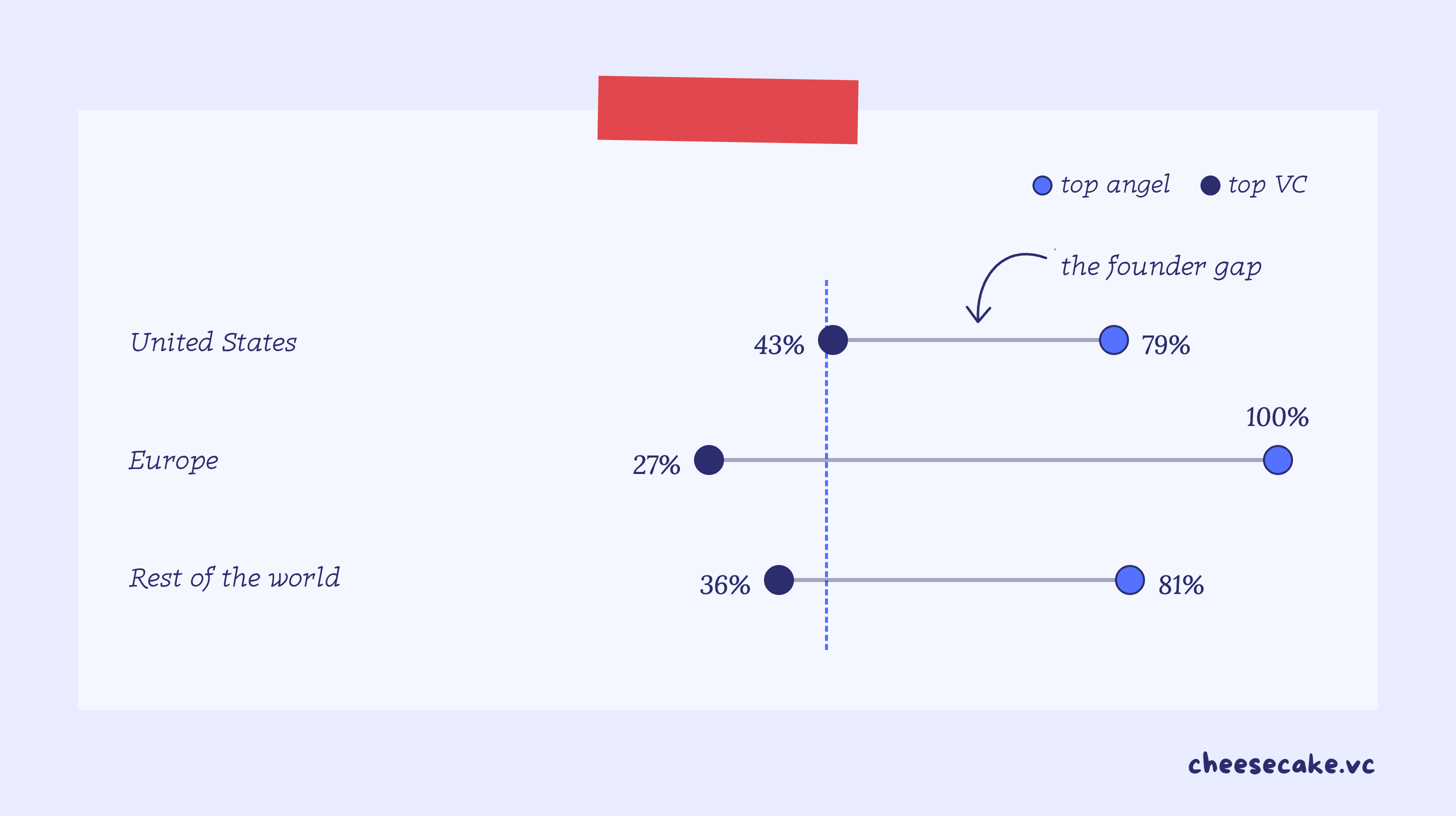
Starting a company is common among the top US angel investors. 79% of the best angels on the list founded a tech startup, and that number goes up to 84% in the top 50. Founders still back about 16% more unicorns than angels who weren’t founders.
But you don’t have to be a founder to make the list. About one in five angels never started a tech company, including Tim Draper (#36) and Henry Kravis (#64).
Going to an elite school is also common (59% of the top angels did), but it doesn’t affect their rank. Max Levchin (#16), Paul Buchheit (#13), Alexis Ohanian (#25), and Marc Benioff (#7) all founded companies, but none went to a school considered elite.
Top US VCs: Many have MBAs, fewer are founders
The VC list measures something different. Strebulaev ranks VCs by the value of their recent deals, while the angel list counts lifetime successes. 14 people appear on both lists.
Less than half of the top VC partners started a tech company (43% vs 42% in the Midas List analysis), compared to 79% of the angels. More than half have an MBA (57 out of 100), and 78% went to an elite school, compared to 59% of angels.
What about Europe?
I tried to do the same analysis for Europe, looking at angels from Dealroom’s Power Law list and Europe-based investors from Forbes Midas List Europe 2022-2025. These are very small samples (13 for angels and 34 for VCs) and use different criteria. Regardless, in Europe, the angel pattern is even stronger, while the VC pattern leans the other way.
All the top European angels with confirmed backgrounds are founders, including the founders of Wise, Supercell, Mollie, and Iliad. This is partly because Dealroom mostly tracks angels who are already well-known founders. For VCs, it’s different.
For VCs, elite schooling is just as common as in the US (78%).
How about other regions?
I looked at top angels and VCs from LatAm, Africa and Asia.
Emerging-market angels are more similar to American ones than European ones: 17 out of 21 confirmed (81%) started a tech company, compared to 79% in the US and 100% in Europe. All 11 confirmed Asian angels did as well. Differences within the region stand out even more. Almost all Latin American angels studied business and most studied abroad, while Asian angels are more likely to be engineers. For emerging-market VCs, the trend is reversed: only 4 out of 11 founded a startup, a significant gap compared to angels.
*The sample is small, with 28 angels and 11 VCs from a few countries.

Take the data with a grain of salt
Every ranking uses different methods. Also, these winner lists can’t tell us whether firms look for certain credentials or whether people with those credentials just tend to go into VC. For now, it’s a good theory to keep in mind.
Seven out of ten angels and 63 of the 100 VCs are based in California, so this reflects just one ecosystem. Some people might say, “You need to be in California if you want to be a great VC,” but that’s only because the data is US-only by design 🤷🏼♀️.
Other data sources:
Forbes Midas List, used for European VCs (the Midas List Europe, 2022 to 2025) and for the Indian and Singapore VCs
NeoFeed: most admired angel investors in Brazil, used for Brazil’s angels
LAVCA Top Women Investors (via Startups.com.br), used for Brazil’s VCs
Forbes México: 50 most influential LatAm angels, used for Mexico’s angels
Moneycontrol: top super angels of 2021, used for India’s angels
Inc42: most active angel investors in India, used for India’s angels
Forbes Middle East: top venture capitalists 2024, used for Egypt’s VCs