


You only get one chance to make a good first impression. And according to the latest research, if you’re using AI for outreach, you are ruining your chance to make a good one.
I get it, you want to be efficient. Everyone is doing it. There is AI content everywhere. AI-generated Substack posts, AI-generated presentations, music…
But using AI to get other humans’ attention is a crime.
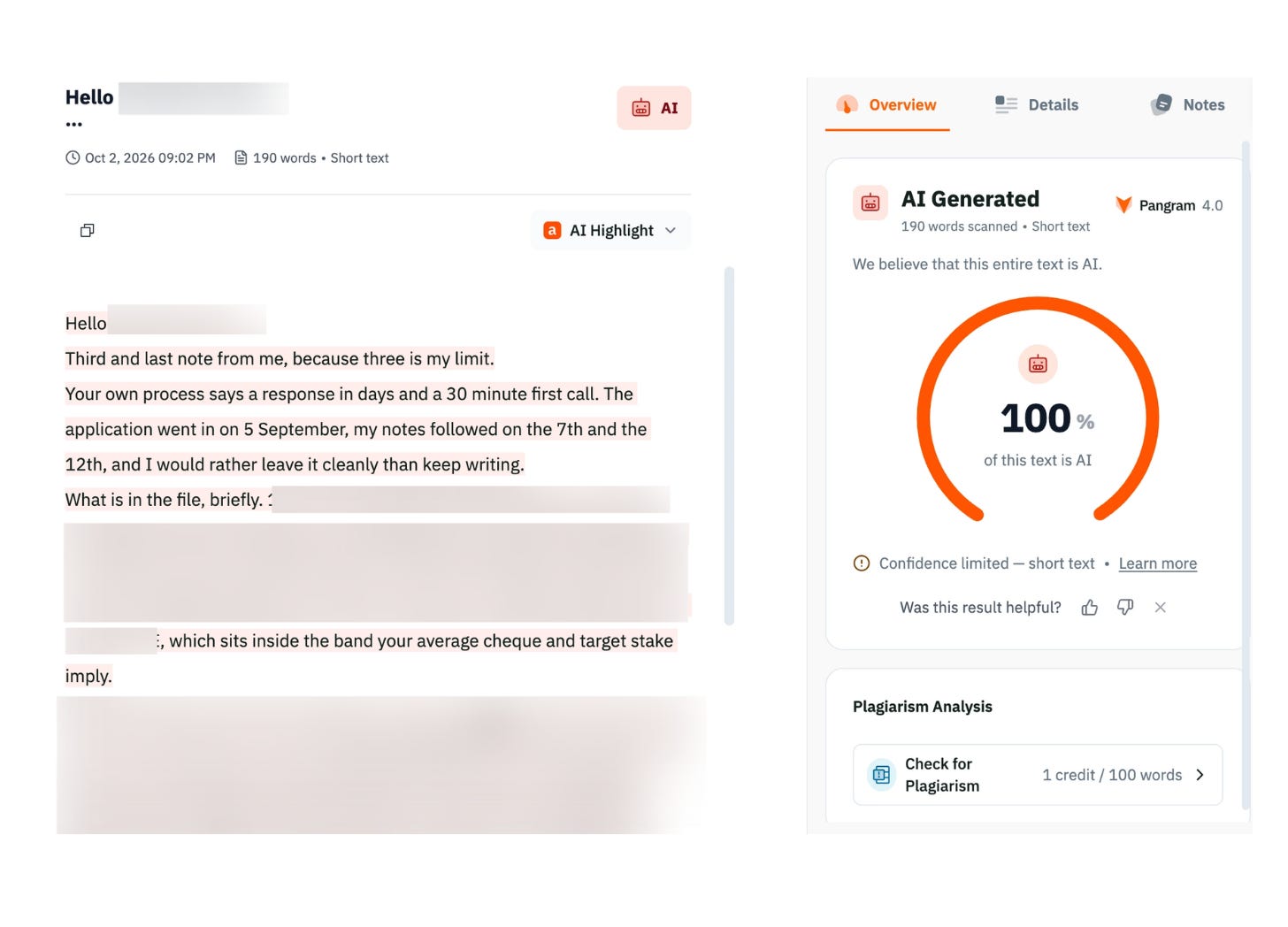
I checked each cold outreach email and LinkedIn message I received in the last month using Pangram. I was shocked. 82% of them were 90-100% AI-generated!
But it’s not only me. The ultimate boss of early-stage investing says the same thing.
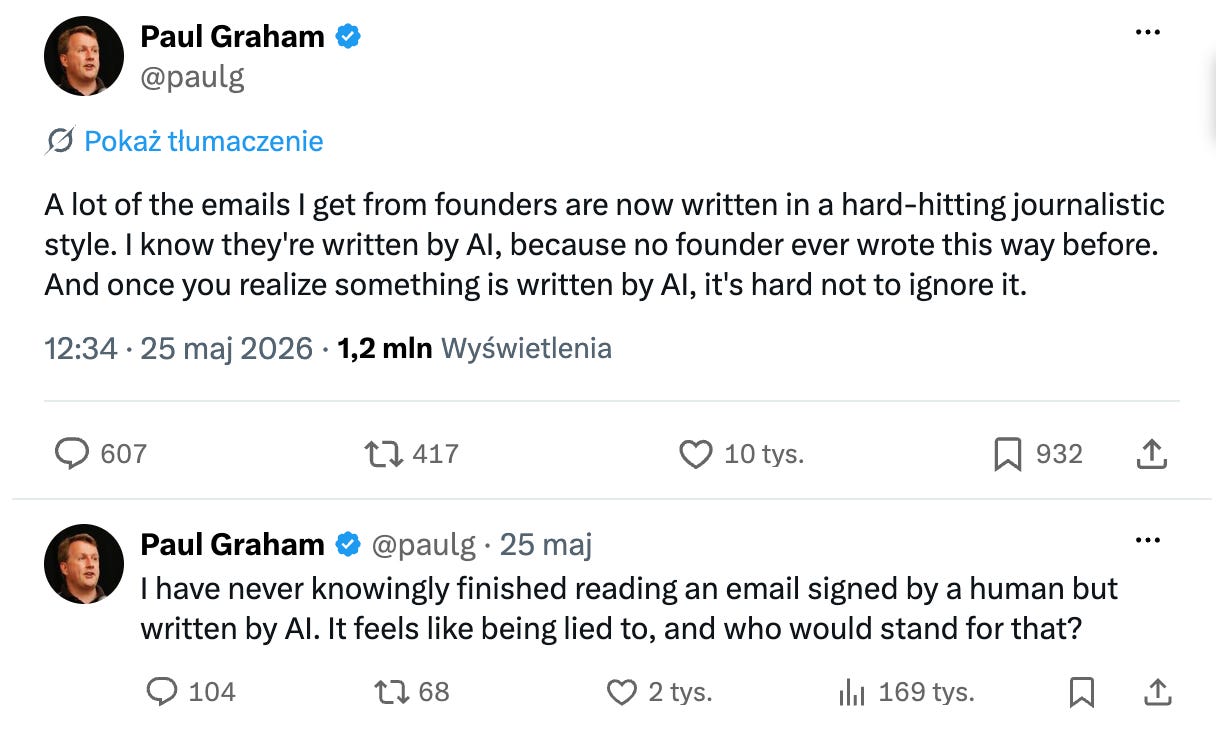
So this tells me some founders think it’s ok, it’s efficient, and maybe that investors don’t mind it at all. At the end of the day, they should be the strongest “tech advocates”.
For most, it’s not ok. Let’s nerd about it.
Making a good first impression
Obviously, you reach out to people for a reason (in this context, a business reason). Getting in touch and making a bad first impression is pointless because it gets you nowhere near your goal of making a connection. But that’s exactly what happens with AI-automated outreach. The message itself isn’t the main issue here, but what the text makes the recipient infer about the person behind it.
Here’s what we know:
Firstly, people form first impressions extremely quickly. In fact, research suggests that we don’t consciously decide to form a first impression; our brains do it automatically (Source).
Secondly, people form opinions about you before they have enough information to evaluate you properly. People can also form impressions about others from surprisingly little information (Source).
Third, research suggests that two fundamental dimensions matter most in how we perceive other people: warmth (whether someone seems well-intentioned) and competence (whether someone seems capable) (Source).
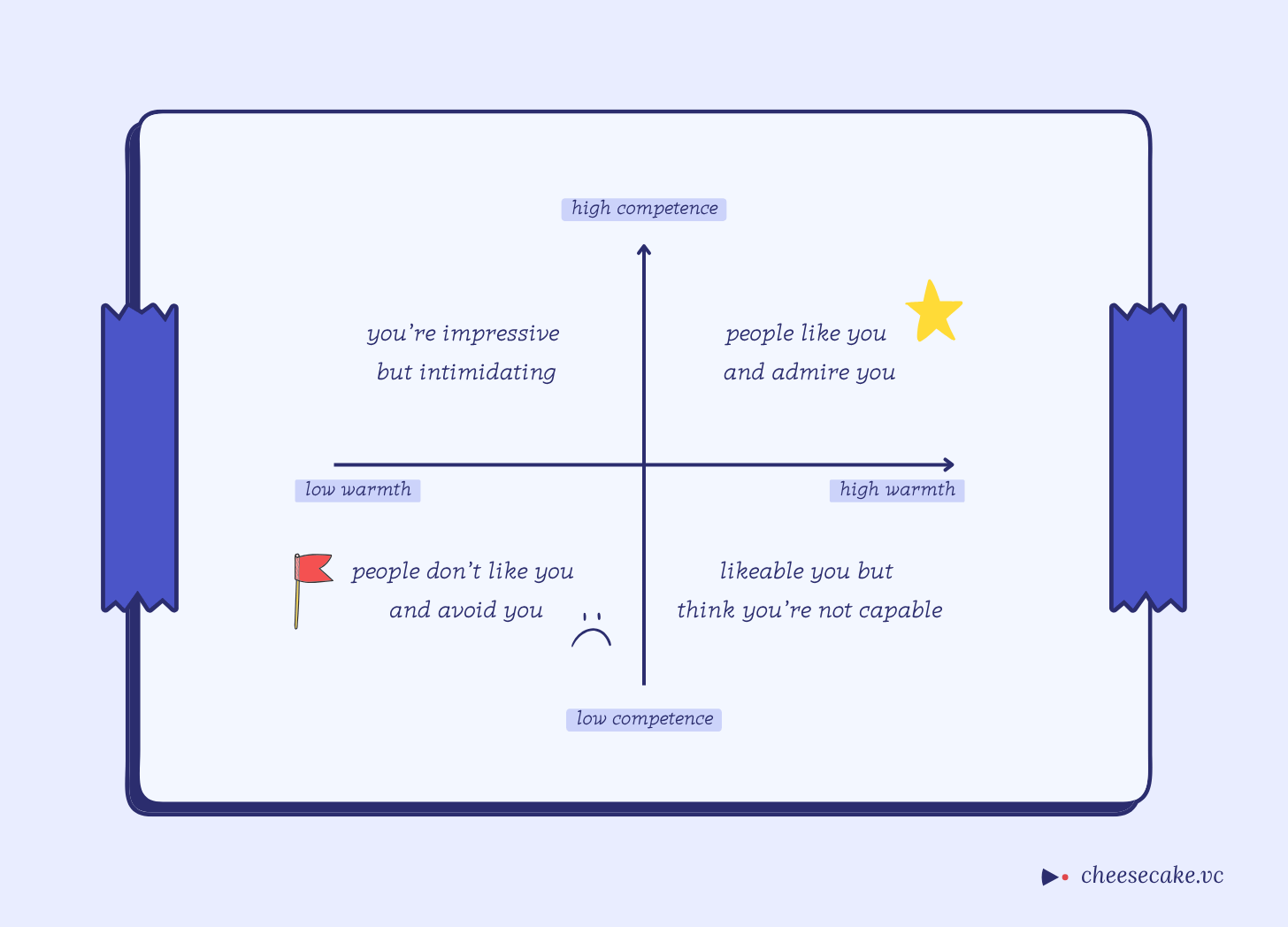
In other words, when you send someone a message, they’re evaluating you, not the message.
The AI Ick
And this is where AI makes things more complicated. Research suggests that when people know AI wrote a message, they judge the person behind it differently.
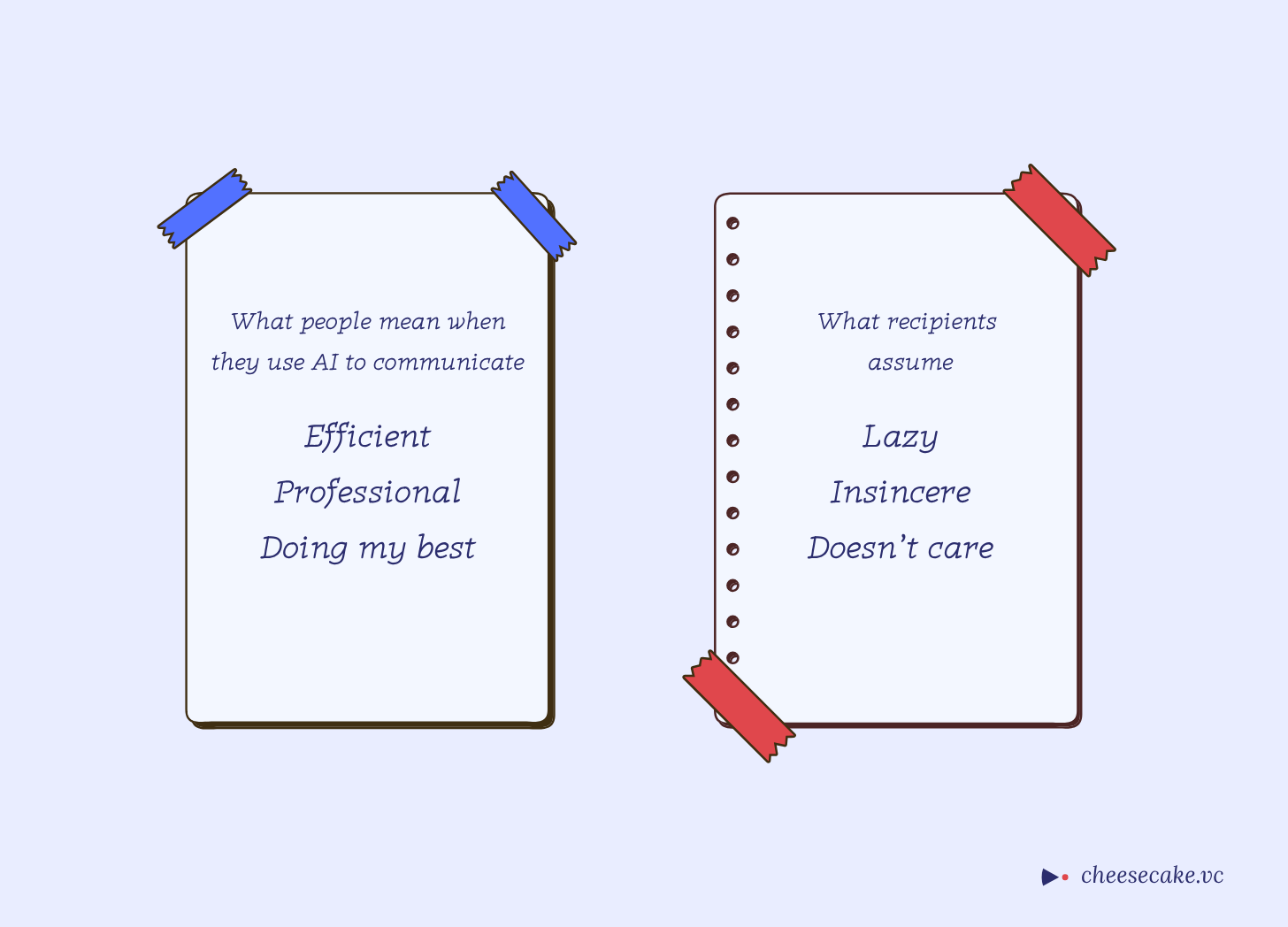
In a recent study published in Computers in Human Behaviour, participants who knew a message had been AI-generated formed more negative impressions of its sender as a person, associating them with qualities such as being “lazy,” “insincere,” or putting in less effort.
AI use, then, matters a lot for first impressions. When people know someone has used AI, they perceive that person as less competent and less warm 🚩🚩🚩.
People quickly infer the person behind it: “If you used AI to write this message, how much did you actually care about sending it to me or the topic you’re writing about?” (Source)
The irony is that the sender may have used AI because they cared about being efficient, professional and just doing it to the best of their abilities. The recipient, on the other hand, may interpret the same behaviour as evidence that they didn't care enough to put in the effort.
In the VC-startup context, it’s hard not to think of AI-generated messages in the following way:
1. This person who sent it is desperate to fundraise.
If you blast the same AI-personalised message to hundreds of investors, it can look like you’re hoping that volume will compensate for a lack of interest. As much as no one wants to date someone desperate, no investor wants to invest in desperate companies.
2. This founder isn’t taking this seriously enough.
If you’re asking someone to invest in your company, why outsource the very first impression you can make to a machine?
Of course, those are interpretations. A founder can be highly committed and still use AI to write an email. But first impressions are built from the signals available to us.
What works then
Cold outreach isn’t going anywhere. But it needs to be more thoughtful than ever before.
I actually do a fair amount of cold outreach myself, mostly to find potential executive advisors and board advisors for companies we invest in. These are often people I have never interacted with, in different countries, and in very senior positions.
My process is a classic human-in-the-loop, with a simple rule: automate the work, not the relationship.
So no, maybe it’s not the most scalable process. But since my objective is to build a relationship, automating the very first message to the person I want to build a relationship with has never seemed like a good option. Here’s the process that works for me:
1. Research the right people
I use Claude/Grokbot (his name is Richard) and Apollo to research who I should actually reach out to.
To get one advisor, I typically target about 20 profiles that meet my founders’ criteria.
2. Enrich the data
Apollo helps me find the relevant contact information and enrich the profiles.
3. Decide how to reach out
I manually review the profiles and decide whether LinkedIn or email makes more sense. My response rate is usually higher on LinkedIn, and I choose LinkedIn if I see that the person is active there. I choose email if they aren’t.
I tend to use LinkedIn more often because I like that the person can immediately click on my profile and see that there is a real human on the other side.
4. Draft the v1 of the message
This is where I happily use AI. For email outreach, Grok writes drafts for me and leaves them in my Gmail drafts. For LinkedIn outreach, Grokbot prepares a document with a link to the LinkedIn profile and a suggested message.
Of course, Grokbot and Claude are supposed to know my writing style, but it’s still not quite there, so the next step is…
5. Humanise it
I read every single message. I make sure it sounds like me.
I’m not a native English speaker, so I do use Grammarly; I have been Grammarly-maxxing since my master’s degree in the UK in 2017. But that’s very different from asking AI to create an impression of me.
**Sent**
AI can help me get to the starting point faster, but it never decides how I sound.
Of course, it’s cold outreach, so response rates vary. I also don’t reach out to 1000 people a month, so I know it might not apply to everyone.
At the end of the day, I’m not trying to convince anyone to stop using AI for outreach. Quite the opposite! As much as it’s a crime to use it in the first message, it’s also a crime not to leverage it to find people, enrich the data and set follow-up reminders (Grokbot is also great for follow-ups).
Because AI will make it increasingly easy for everyone to sound personalised, and when everyone can sound personalised, sounding human may become the real competitive advantage.