



I’ve been working with early-stage founders for nearly a decade, both on the investment and portfolio sides of Venture Capital. I invested in and/or worked with nearly 200 founders from about 50 countries who built startups serving customers worldwide. And what I saw recently blew my mind.
My job is to make sure that we are the favourite investor on the cap table of every founder we back. So obviously, negotiating software and services discounts for our portfolio companies is a part of it.
Over the past year, something changed.
As AI tools accelerated, the requests from portfolio companies changed. Founders weren’t just passively browsing what we had available. They were actively asking us to source specific tools, negotiate discounts with AI providers, and add new partners. The demand for anything that reduces building costs, whether cloud credits, AI tools, or dev platforms, went through the roof.
I’ve seen how founders react to every major perk we’ve ever offered, including OpenAI credits. I know what “strong interest” looks like.
When we onboarded Lovable to our perks platform, the redemption interest was unlike anything I’d seen before.
Here’s the actual screenshot of my inbox 👇
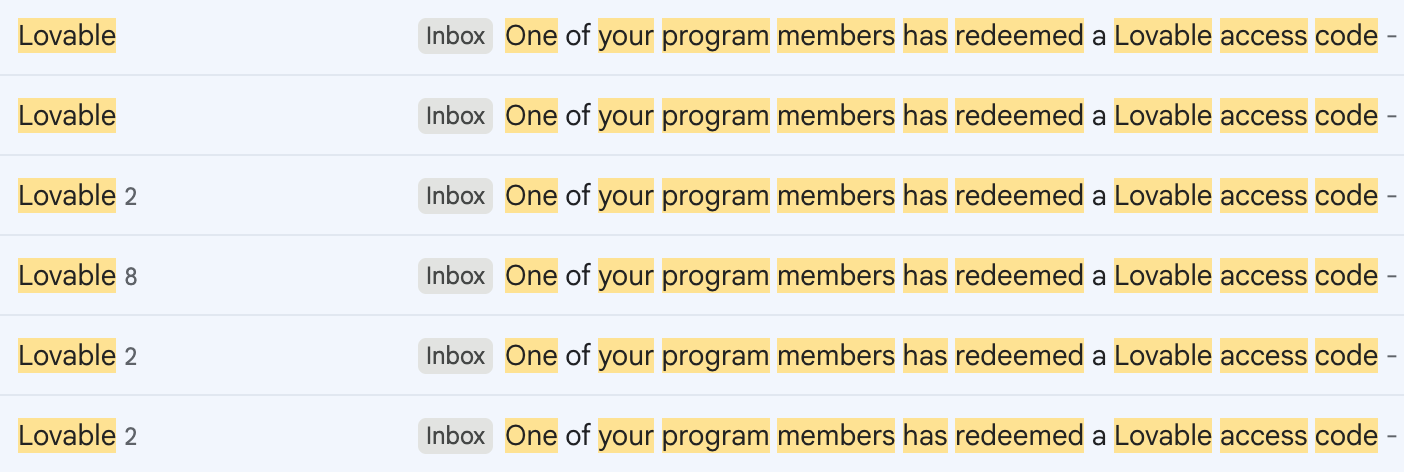
When founders in São Paulo, Lagos, Nairobi, and Jakarta all reach for the same tool, that tells you something. And for me, the best signals are the ones that come from my portfolio. So I started digging. Why Lovable? Why is the interest so strong?
The gap
Here’s what most people in developed markets don’t realise about building software in emerging economies: the developer supply simply isn’t there.
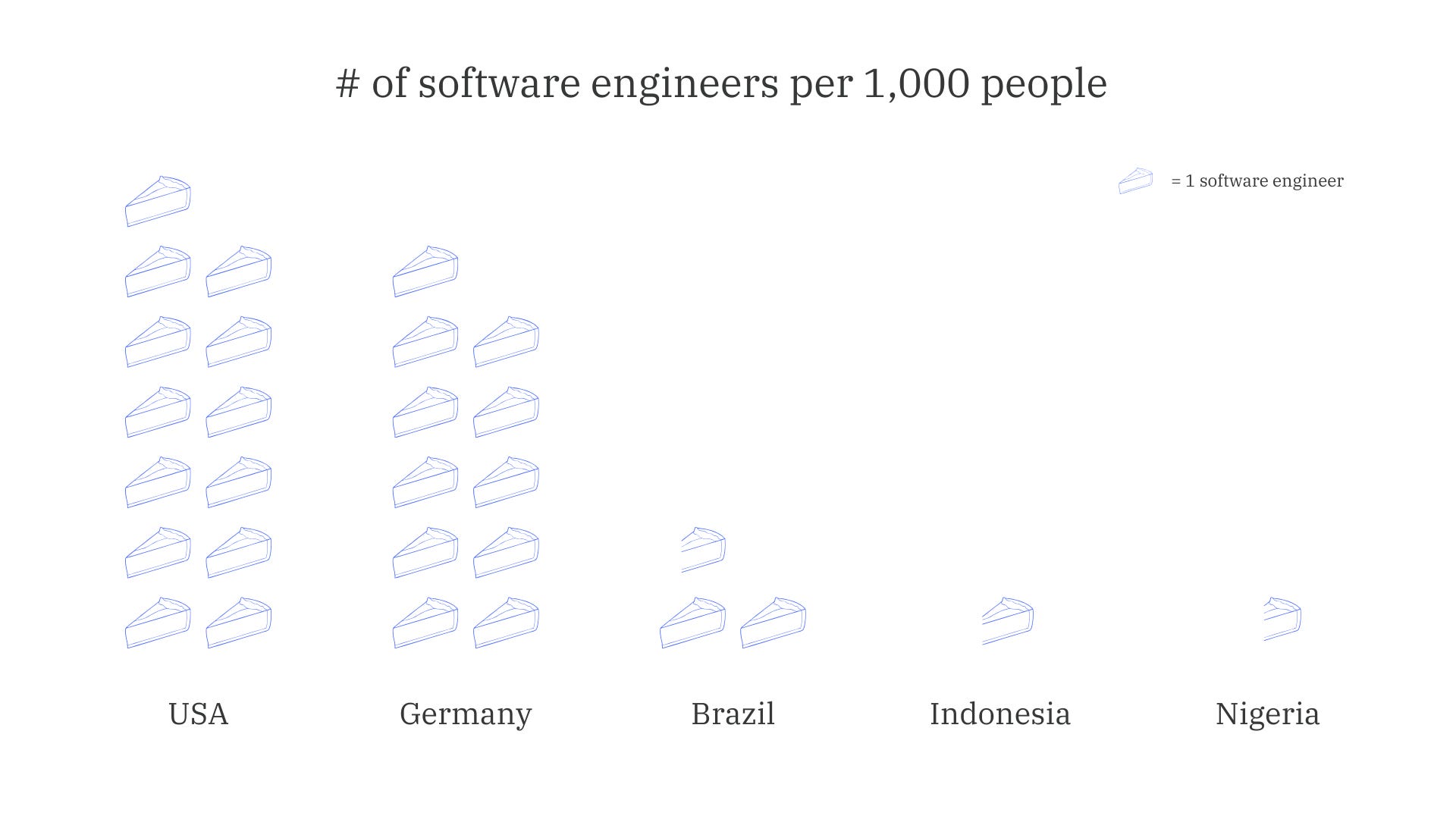
The US has roughly 12.9 software engineers per 1,000 people. Western Europe averages a similar range: the UK sits at 13.2, Germany at 10.8. Now compare that to the fastest-growing emerging markets. Indonesia has 0.71. Nigeria has 0.48. Brazil, the largest economy in Latin America, has 2.3. The talent pool in these markets is a fraction of what founders in San Francisco, London, or Berlin take for granted.
And the SaaS landscape mirrors the same gap. The US has about 80 SaaS companies per million people. Brazil has 2.4. Indonesia has 0.4. Nigeria has 0.4. That means there are entire categories of business problems in these markets for which no software solution exists, in any language or at any price.
Only 8% of global private capital is deployed outside the Big Six economies (the US, China, India, Germany, the UK, and Israel), despite these markets representing 38% of global GDP. The capital mismatch is well documented. But the tooling mismatch gets far less attention. In developed markets, no-code saves you time and money. In emerging markets, it may determine whether something gets built at all.
Why now, and why here
Four things are converging, making this moment different.
These are the youngest societies on earth. The median age in Nigeria is 18. In Kenya, it’s 20. In Indonesia, 31. In Brazil, 35. These populations grew up with smartphones in their hands. They are digitally native in ways older demographics in developed markets often aren’t. When you combine that digital fluency with newly accessible building tools, you get a generation that’s ready to build now.
The tools got good enough. Lovable lets you describe a product in plain language and get a working, full-stack application. According to Lovable, 67% of its users have little to no coding experience. This matters because the AI-assisted building threshold has crossed a line into usable output. Some of our portfolio companies are already using Lovable to prototype products before committing to a full engineering build, a smart way to validate ideas without burning through months of runway.
The people closest to the problems can finally solve them. This is the part that excites me most. Emerging markets are full of people who have understood local gaps for years but never had the technical means to address them. Now they can. And they bring something that no Silicon Valley SaaS company will ever replicate: deep local context. They know the workflows, languages, payment habits, and cultural nuances that shape how business actually runs on the ground. 76% of consumers globally prefer to buy in their native language.
Linda Rottenberg, Endeavor’s CEO, made this point powerfully in her 2025 Gala speech: the companies building foundational AI models are based in Silicon Valley and China, but the application layer, where AI meets lived experience, is being built elsewhere. The founders she highlighted didn’t set out to build AI. They set out to solve problems that matter. Tools like Lovable accelerate exactly this pattern.
The cost math finally works. $25/month puts serious building capability within reach of entrepreneurs across markets where custom software projects usually cost tens of thousands of dollars, and often much more. This price point unlocks a massive population of builders who were previously priced out entirely.
What’s still in the way
The opportunity is real, but there are bottlenecks.
The biggest one is payments. Credit card penetration remains very low in many emerging markets (for example, in sub-Saharan Africa, an estimated 3-5% of people use credit cards). You can build the most accessible development platform in the world, but if people can’t pay for it, it doesn’t matter. The mobile money infrastructure already exists in many of these markets, and no-code platforms that integrate with local payment systems will unlock these markets.
Language is the other bottleneck. Most no-code platforms are English-first, but English proficiency varies widely across emerging markets. As AI-powered interfaces get better at accepting prompts in Arabic, Portuguese, Hindi, and other local languages, the addressable market will expand significantly.
The future is bright
The cost of building software just dropped by an order of magnitude, and the people who benefit most are the ones who had the least access to begin with. The no-code AI market is projected to reach $37-44B by 2033. But the more interesting thesis is what gets built on top of these platforms in underserved markets. A flagship example is a Brazilian EdTech company, Q Group, which generated $3M in revenue within 48 hours of launching a premium product for its existing user base, built on Lovable.
Endeavor’s data shows there are now over 1,400 unicorns globally, half outside the US. Their question resonates: if founders from overlooked markets have already built this much with limited tools, what happens when they get everything they need?
I think we’re about to find out. And I think no-code platforms will make a massive contribution to the development of emerging market economies.