


Last year, I was under more pressure to build agentic workflows than to have a baby (and I am a married woman over 30).
Tech has always been all about efficiency and automation. With AI, it’s getting ever easier to automate.
Before the agentic wave, I vibe-coded my own automations in n8n. I was very proud of a screenshot categorisation tool I built that took me 2 hours to wire together Telegram, Cloudflare, and a library in Notion. Today I could set up the same thing with one agent in less than a minute.
I do love my Grok bots. They do all sorts of stuff that frankly adds absolutely no value to me as an investor and operator. They’ll prepare a note for my weekly team catch-up; they’ll do the invoices... It’s all absolutely boring!
At the same time, it’s so easy to get swept up in the efficiency of it all that you’re tempted to go fully automated and just become a bot manager. But on the other hand… I chose this career, so why the hell would I want to automate the very things that make me good at it?
This brings me to the point - some things just shouldn’t be automated. Last week Hilary Gridley (one of my absolute favourite Substack writers) published an essay on writerbuilder entitled “What not to automate“, and that’s what inspired me to think about my own approach.

She categorises work as downhill and uphill:
“Downhill is when I’m just trying to get somewhere, and all that matters is getting there. If I’m headed downhill anyway, why not take the sled?
Uphill is different. Uphill is the climb that makes me better at something. Struggling through an essay makes me a better writer and a better thinker. Struggling through formatting that essay in Substack does not.”
It made me think about which parts of my job push me uphill, and what I’ve been subconsciously unwilling to automate, despite all the pressure (both external and internal) to automate myself as much as possible.
I landed on these 6:
(1) Researching a topic
AI is extremely useful in getting you to the right sources and the articles / people that are worth reading.
But to me, good research is a bit like sightseeing in a new place. You’ve got a destination in mind, you go there, and you see all sorts of interesting things along the way. The little details are what make it such a good trip.
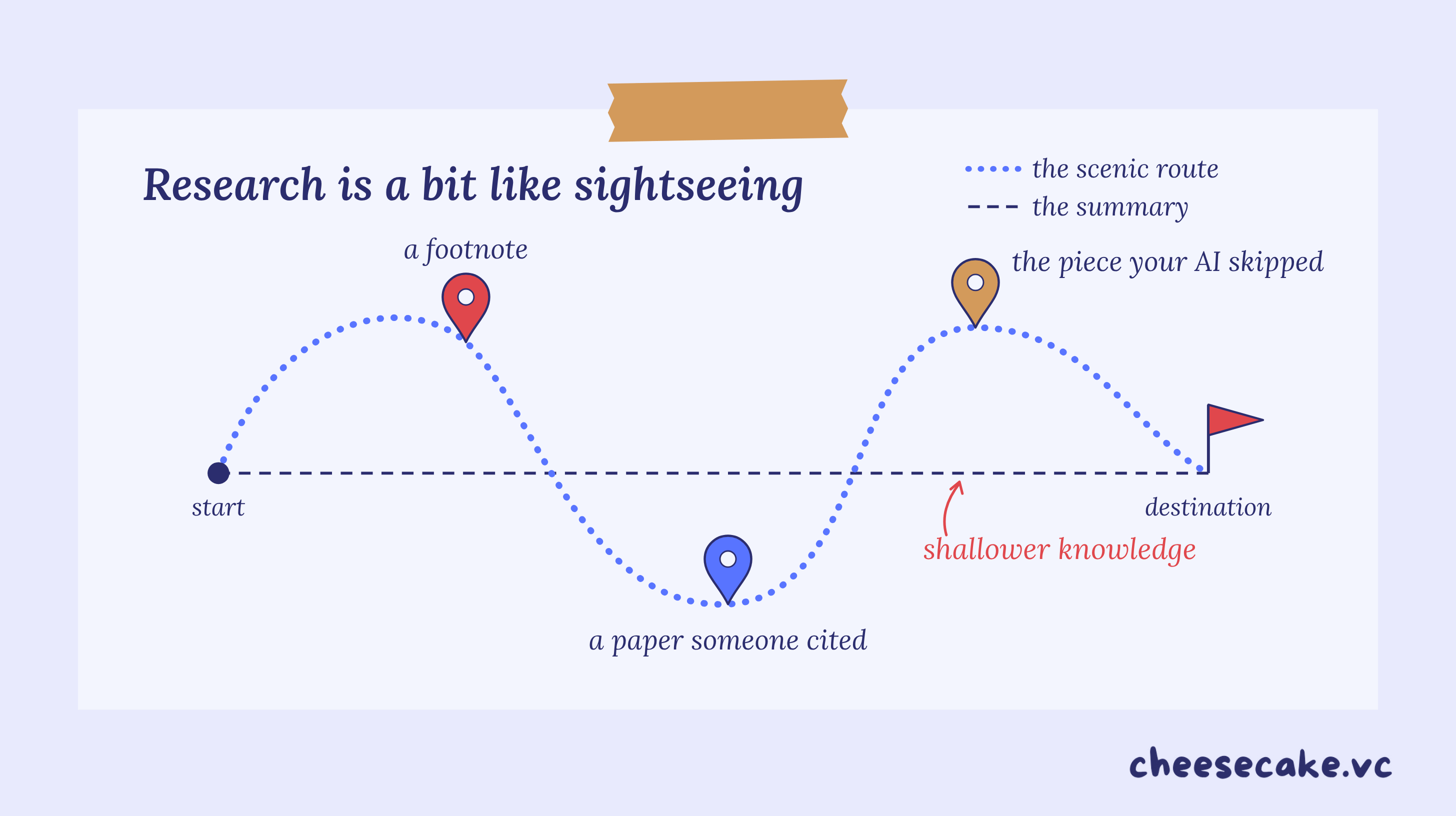
Research works in the same way. There’s value in just going through the material, combining all the different perspectives in your head and coming up with a piece of something that someone else referenced, which your AI completely missed because it didn’t quite match your prompt.
Shiri Melumad (Wharton) and Jin Ho Yun (New Mexico State University) looked at this in 7 experiments with thousands of participants. People were taught about a topic (e.g. how to plant a vegetable garden) either via an LLM (e.g. ChatGPT) or via a standard Google search and then were asked to write some advice on it. The group who’d used the LLM spent less time with their sources, felt they knew less and produced shorter advice with fewer facts. In a separate study, 1,501 of the readers (who didn’t know which group had produced the advice) rated the advice produced via the LLM as less helpful and less trustworthy. The authors conclude that “relying on pre-synthesised summaries can transform learning from an active quest to a passive activity” (PNAS Nexus, October 2025).
The pattern predates AI. When the scientific journals moved online, James Evans looked at 34 million articles and found that researchers were citing fewer papers, and those they did cite were more recent (Science, 2008). His explanation was that search and hyperlinks get you to the consensus much faster. A summary gets you there even faster, by skipping the detours.
(2) Thinking through a deck
The second thing I wouldn’t want to automate is actually a fairly big part of deck making, which is working out how we want to communicate something and what actually goes on the slides.
People hate presentations, but a deck is still one of the clearest ways of presenting an idea with visuals. You can quite easily spot which decks have been produced by AI and I don’t think there’s anything wrong with that at all. In Hilary’s terms, building the deck is the downhill side.
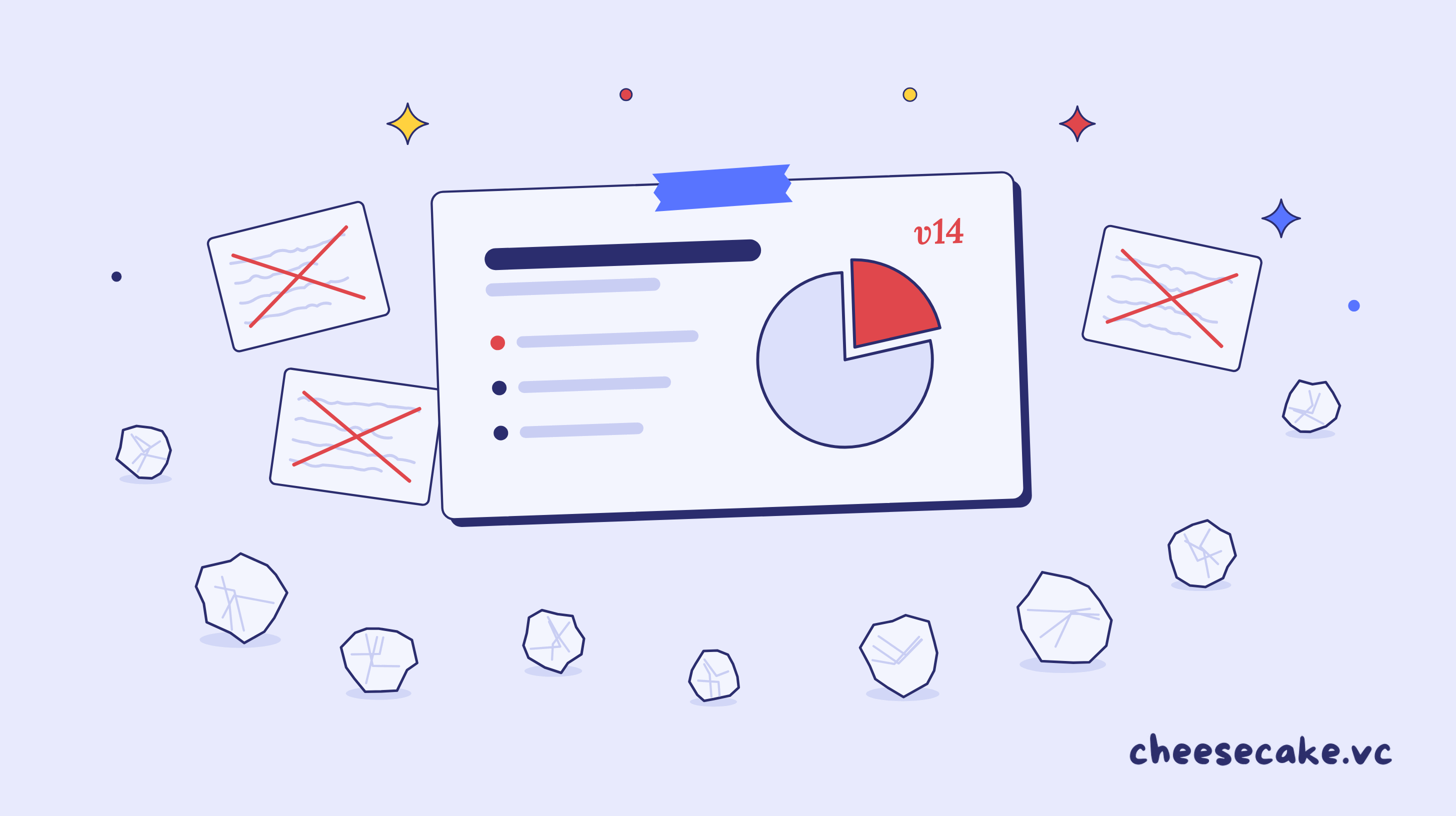
Deciding what to say is the hard bit. Every time you’re selling an idea, a project, a startup or a fund you’re going to have to work through the deck and think very carefully about how you’re going to tell the story and how you’re going to say it.
Like a good speech or letter, the shorter the piece, the more thought it takes. Blaise Pascal apologised for exactly that in one of his letters, in a now famous line: “I have made this longer than usual because I have not had time to make it shorter.” That’s why startups spend weeks preparing for a three-minute pitch at demo day.
If you’re having AI do the deck then you skip the drafts that you’d normally show your colleagues, their feedback and the subsequent iteration. Those conversations are often where relationships get built, too.
(3) Portfolio conversations
This is the one that’s obvious. Part of my VC job is matching up our portfolio companies with executive advisors. A large element of that could be automated: agents collecting information from the investment memo and the investor updates that the company sends, what it needs from an advisor, perhaps a form for the founders to complete.
I still prefer to do it on a call and go through all the interesting bits together, because a call gives me far more data and lets me build a relationship with the founder.
(4) Networking (and I mean actually talking to people)
AI is absolutely great at finding people. I’ve got a Grokbot that suggests who I should connect with on LinkedIn and Substack. It’s been a massive game changer and has helped me find loads of interesting people.
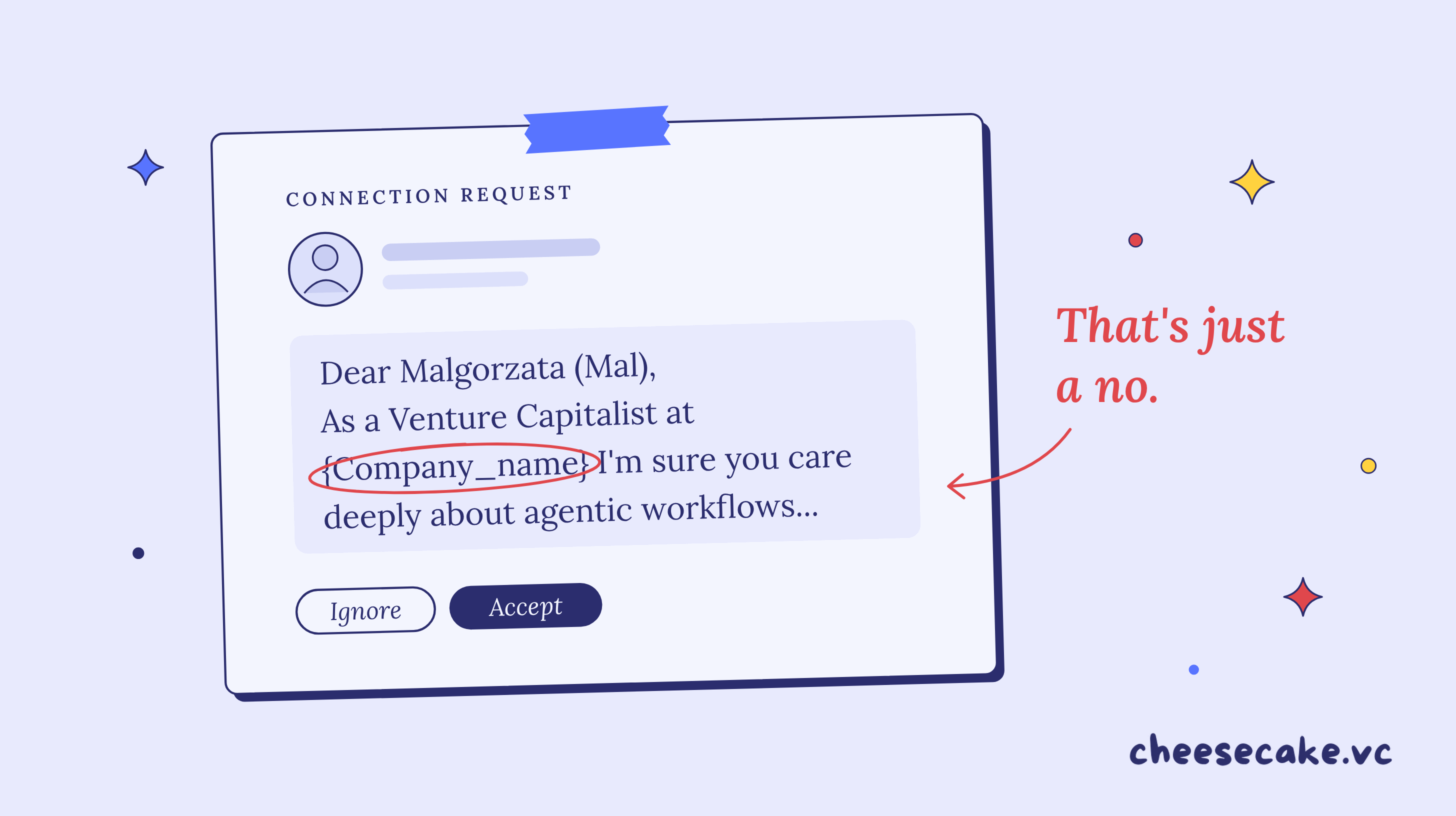
At the same time, I think using AI to communicate with other human beings should be a crime. Things like writing AI-generated (often automated, badly) comments to engage with someone on social media, and sending automated emails where the first line is “personalised” in a very fake way, are just so cringe!
(5) Writing
There’s a very big difference between outsourcing the editing and outsourcing the thinking. As historian David McCullough put it:
Writing is thinking. To write well is to think clearly. That’s why it’s so hard.
Whenever I try to put my thoughts together with a bot, or in Notion, the result is never as good or as crisp as going offline, taking a pen and writing down everything I want to say. Then I build on it, and yes, I use AI to look for other avenues and perspectives. But never for the very first draft. The first draft is where the thinking happens, and that’s exactly the part I want to do myself.
(6) Understanding ecosystem depth and market sentiment
AI is absolutely invaluable for podcast, news, and event summaries at both the macro and micro level in the markets I focus on. That said, at the very early stages of venture investing, you do still need to talk to people to get a feel for what’s going on and what your stakeholders actually think.
When something major happens politically in one of our markets, I don’t want to outsource forming my view. I’d much prefer to talk to the startups on the ground and hear how they describe what’s going on.