


Hello! 👋
Mal here. I’m a venture capitalist working closely with startups across Asia, Africa, MENA, CEE and LatAm. I also spend an unreasonable amount of time thinking about venture capital and cheesecakes.
I share my notes, thoughts and research via this Substack. (Yes, on both.)
For years, the tooling conversation in VC was mostly about software shopping: Which CRM are you using? Who moved from Affinity to Attio? What are you using for portfolio KPI tracking?
But it’s changing now. If you spend time around VC operators, platform teams, or people close to the fund’s internal workflows, you can feel the shift already.
The more interesting question now is no longer what tools you use, but what you are building in-house. Early this year, my favourite Elena Verna wrote an article, “Why every exec should be vibecoding.” The VC crowd seems to have taken that advice very seriously!
What follows is a curated collection of the most recent case studies showing what some of the more forward-leaning VC firms are already building across sourcing, investment analysis, portfolio support, and beyond. If you want to understand where the operating edge in VC may be heading next, this is a good place to start.
1. Finding deals
Ada Ventures’ Deck Genius
What: An AI-powered pitch deck review tool that gives founders fast, detailed feedback before they start pitching investors. It sits between founder support and sourcing, but it’s clearly a top-of-funnel tool: Ada describes it as a new touchpoint with founders before they formally seek funding.
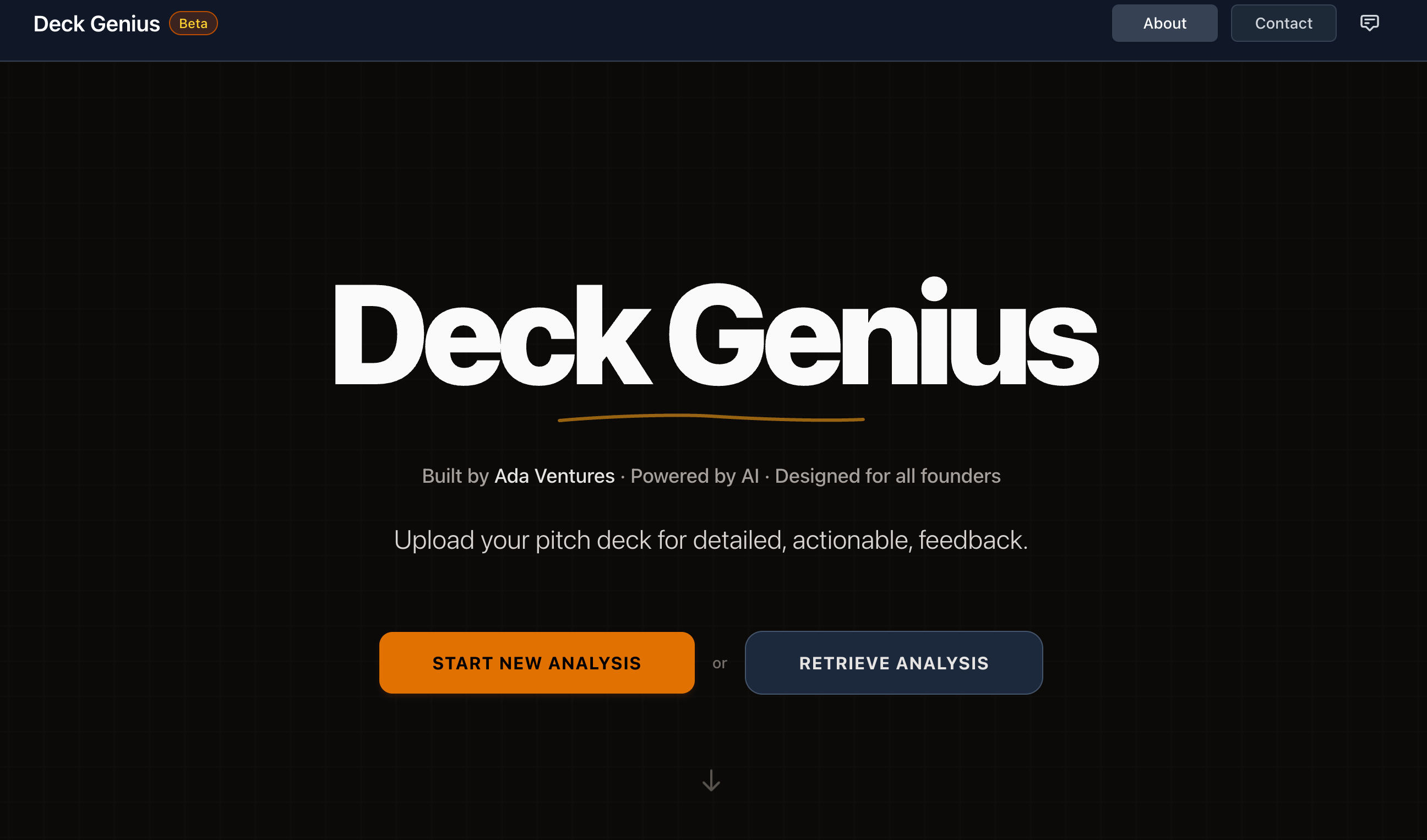
What problem it solves: Most funds cannot give high-quality feedback to the thousands of decks they receive. Founders get little signal, and investors lose a chance to improve the quality of inbound deal flow. Ada’s answer was to turn that early screening and feedback layer into software. The earlier AdaGPT version was already being used by more than 200 founders per month, and Ada said one company that used it later received a term sheet. Three months after launch, Deck Genius had processed 1,091 decks in three weeks.
How: Michael Tefula rebuilt the system from scratch. Deck Genius runs 20 to 50 LLM calls in the background across three areas: narrative, design, and venture fundamentals. It delivers slide-level and holistic feedback in roughly 30 to 90 seconds.
🛠️ Tools used: Cursor, Claude, Codex, multi-step LLM workflows
Source: “Could a VC create an AI to tell founders what investors would really think of their pitch deck?”, Pathfounders; Michael Tefula’s LinkedIn post
Fika Ventures’ Job Post Intelligence Tool
What: A lightweight, self-hosted job-post intelligence tool that monitors companies’ career pages across multiple ATS platforms and sends a Slack alert the moment a new role goes live.
What problem it solves: Hiring is one of the clearest external signals of startup momentum, but it is difficult to track systematically. Job openings are fragmented across different ATS platforms, manual checks are tedious, and important changes are easy to miss. The tool turns scattered public hiring data into a live signal layer that helps investors monitor growth, hiring velocity, expansion into new functions, and competitive movement.
How: The system runs on a scheduled cron job, queries each company’s ATS endpoint, compares fresh job postings against a local SQLite database, and triggers a Slack webhook whenever it detects a new role. This allows the team to monitor hiring velocity across portfolio companies and other target companies without manually checking dozens of career pages.
🛠️ Tools used: Node.js 18+, SQLite, Slack, cron, public ATS APIs
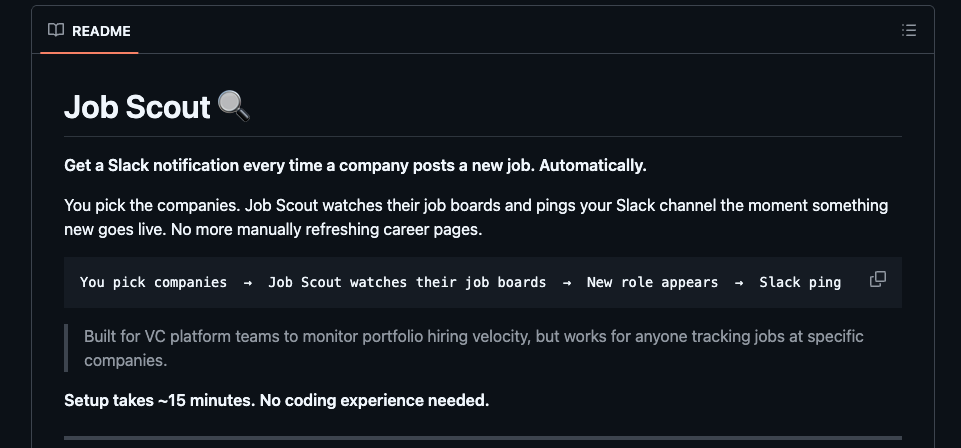
The best part is that the tool is available for everyone to try and customise here.
Source: “We Built a Job Post Intelligence Tool for VC’s — and We’re Open Sourcing It”
2. Evaluating deals
Airtree’s research agent
What: AI agents that automate parts of the investment process, including company research, meeting preparation, deal analysis, and routine due diligence formatting.
What problem it solves: A large share of early-stage investment work is repetitive knowledge work: gathering information, following leads, synthesising findings, and turning all of that into an internal brief. Airtree’s goal is to eliminate hours of manual prep and speed up analysis, without replacing investor judgment.
How: Jackie Vullinghs describes Airtree’s company research workflow as agentic because it searches multiple data sources, decides which leads to follow, loops back when initial results are thin, and synthesises across sources. Airtree’s view is that most real workflows don’t need a complex swarm of agents. A single agent with a ReAct loop and well-chosen tools handles most real-world tasks. Three months in, one of their biggest lessons has been that context management matters more than model selection: their agents get meaningfully better when the team focuses on curating what goes into the context window rather than experimenting with different models. Their research agent now produces a company brief in about three minutes that used to take an analyst a few hours.
🛠️ Tools used: Claude, MCP-based tool connections, ReAct-style agent design
Source: “Building a System of Agents”, Making Connections by Jax
TheVentures’ Vicky
What: An internal AI investment analyst built by Korean early-stage VC TheVentures. Vicky produces structured company analysis and an investment recommendation designed to mirror how the firm’s own investors think.
What problem it solves: Early-stage investing has limited hard data, so much of the work relies on qualitative judgment, synthesis, and memo writing. TheVentures wanted to scale that work without linearly scaling headcount, while keeping the system close to their own decision-making patterns.
How: The firm started by studying how its investors actually make decisions, then translated those patterns into prompts and context engineering. The finished system is a multi-agent setup that uses different LLM providers for different tasks and connects RAG to the firm’s internal database and knowledge base. When a pitch deck, founder profile, one-pager, or meeting transcript enters the system, Vicky generates a structured company summary and a Yes/Maybe/No investment rating with written reasoning. After six months of use, TheVentures said Vicky’s recommendations aligned with human investors about 87.5% of the time. What used to take roughly a week to produce an investment memo now takes about one hour, and the overall response time went from four to six weeks down to one week. The firm also said Vicky surfaced teams that some investors had initially overlooked.
🛠️ Tools used: Multi-agent workflow, multiple LLM providers, RAG, internal dashboard integration
Source: “We let an AI help us decide which startups to invest in for 6 months — here’s what happened”, KRDeals by TheVentures
3. Portfolio intelligence
The post-investment phase presents a different set of challenges. For funds managing large portfolios, aggregating data, staying on top of company news, and keeping institutional knowledge accessible are ongoing burdens.
Point Nine Capital’s Knowledge Hub
What: A homemade version of Glean that allows the firm to ask natural language questions like “How is Company X doing?” and get answers drawing from the firm’s entire institutional memory.
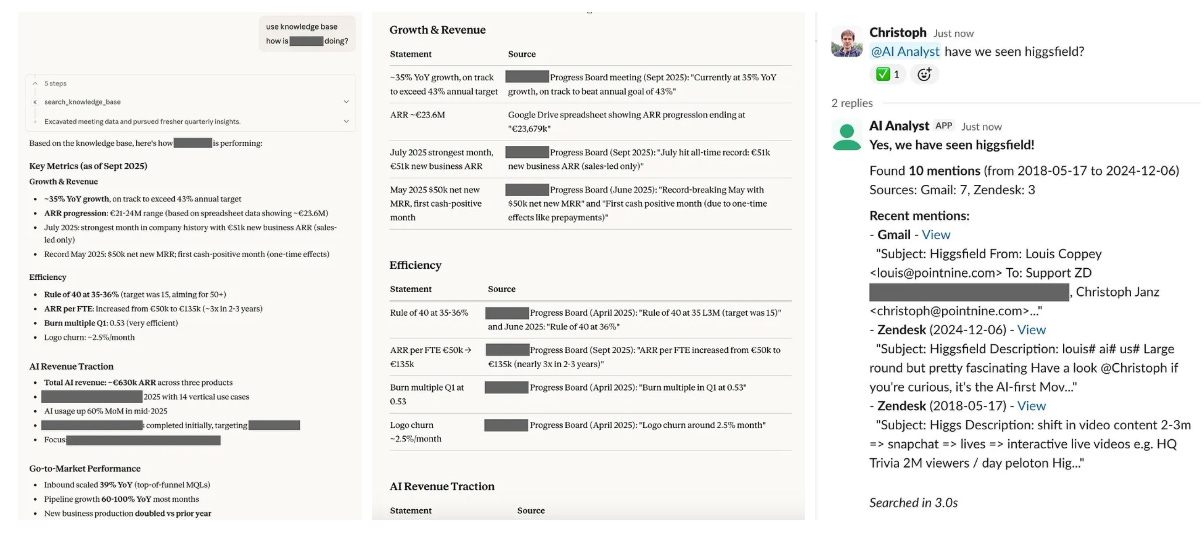
What problem it solves: Institutional knowledge at a VC fund is scattered across email, Slack, meeting notes, CRM entries, and shared drives. Finding relevant context about a portfolio company means digging through multiple systems. The Knowledge Hub centralises it all into a single queryable layer.
How: Over 13 days in January 2026, Managing Partner Christoph Janz vibe-coded the system without writing a single line of code. All 43,800 lines of Python were written by either Replit’s agents or Claude Code. Data from Gmail, Google Drive, Slack, Zendesk, Attio, and Granola is processed into a vector database (Qdrant) with semantic search and connected to Claude via MCP servers. The team can query it through Claude Desktop, Claude.ai in the browser, or a Slack bot. In a follow-up post, Janz explained that he later simplified the architecture by connecting data sources directly to Claude without the vector database, and found that the simpler version delivered most of the value for a fraction of the maintenance.
🛠️ Tools used: Replit agents, Claude Code, Qdrant, PostgreSQL, OpenAI Embeddings, Anthropic Claude, Cohere Reranking, MCP servers
Source: “Some Learnings from Vibe Coding a Knowledge Hub in 13 Days”, Point Nine Land, Medium
AppWorks’ social media tracker
What: An automated social media tracker for 600 portfolio teams, plus a semi-automated X/Twitter engagement system.
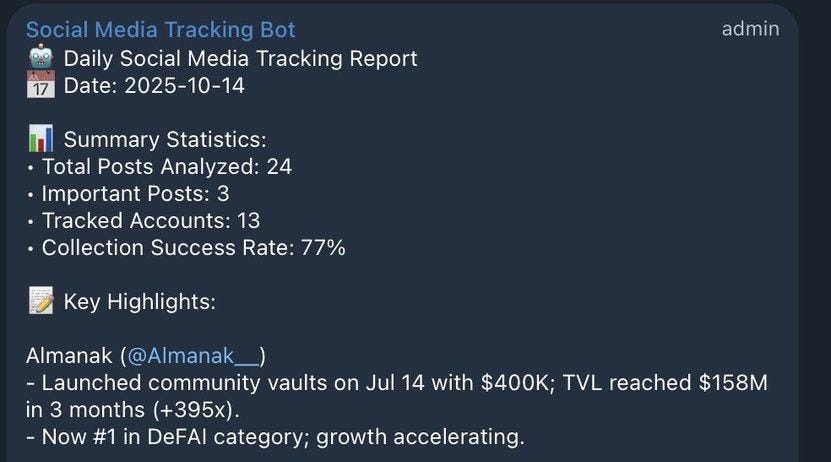
What problem it solves: Keeping up with hundreds of portfolio teams manually is not realistic. Fundraising announcements, product launches, and partnership signals get missed. The tracker turns a daily firehose of social posts into a structured feed of what actually matters.
How: Hsu started with an open-source social media tracking system and customised it. The account list lives in Google Sheets. Posts are scraped across platforms, scored and summarised by AI (with fundraising, product launches, and partnerships weighted higher), and delivered as a daily Telegram summary. The system can also draft short repost-ready messages for the team’s official account.
🛠️ Tools used: Open-source social media tracker (customised), Google Sheets, Telegram
Source: Bill Hsu at AppWorks has been documenting the whole Vibe VC experiment publicly Vibe VC #2: Tracking 600 teams
Alpaca VC’s “Gordon”
What: A proprietary AI system that generates highly specific, actionable prospect lists for portfolio companies.
What problem it solves: Portfolio support often means helping startups find the right customers, partners, or hires. Gordon automates the research and mapping that a human team would spend days doing manually.
How: In one instance, Gordon produced a list of 50 high-value prospects (academics, pharma execs, former FDA leaders) with exact connection routes for a startup called Autopoiesis Sciences, helping Alpaca secure a $1M allocation in a competitive round. At the same time, this is a portfolio support tool: it helps existing portfolio companies grow, not the fund find new deals.
🛠️ Tools used: Proprietary system (specific stack not publicly disclosed)
Source: “Deep Dive: As Smaller VC Firms Build AI Tools To Compete”, Upstarts Media, December 2025
4. Fund infrastructure
Beyond the investment workflow itself, VCs are automating the “firm building” layer: LP reporting, internal finance, CRM, and team coordination. This is the plumbing of a fund, and it has historically consumed a disproportionate amount of time relative to its strategic value.
Union Square Ventures’ agents
What: A custom internal web application and database powered by background agents, each with a name and a job: Sally (meeting transcription), Ellie (email monitoring), Felix (finance data), Arthur (deal analysis), Connor (calendar monitoring). The system was built to make USV’s internal context structured, retrievable, and continuously updated.
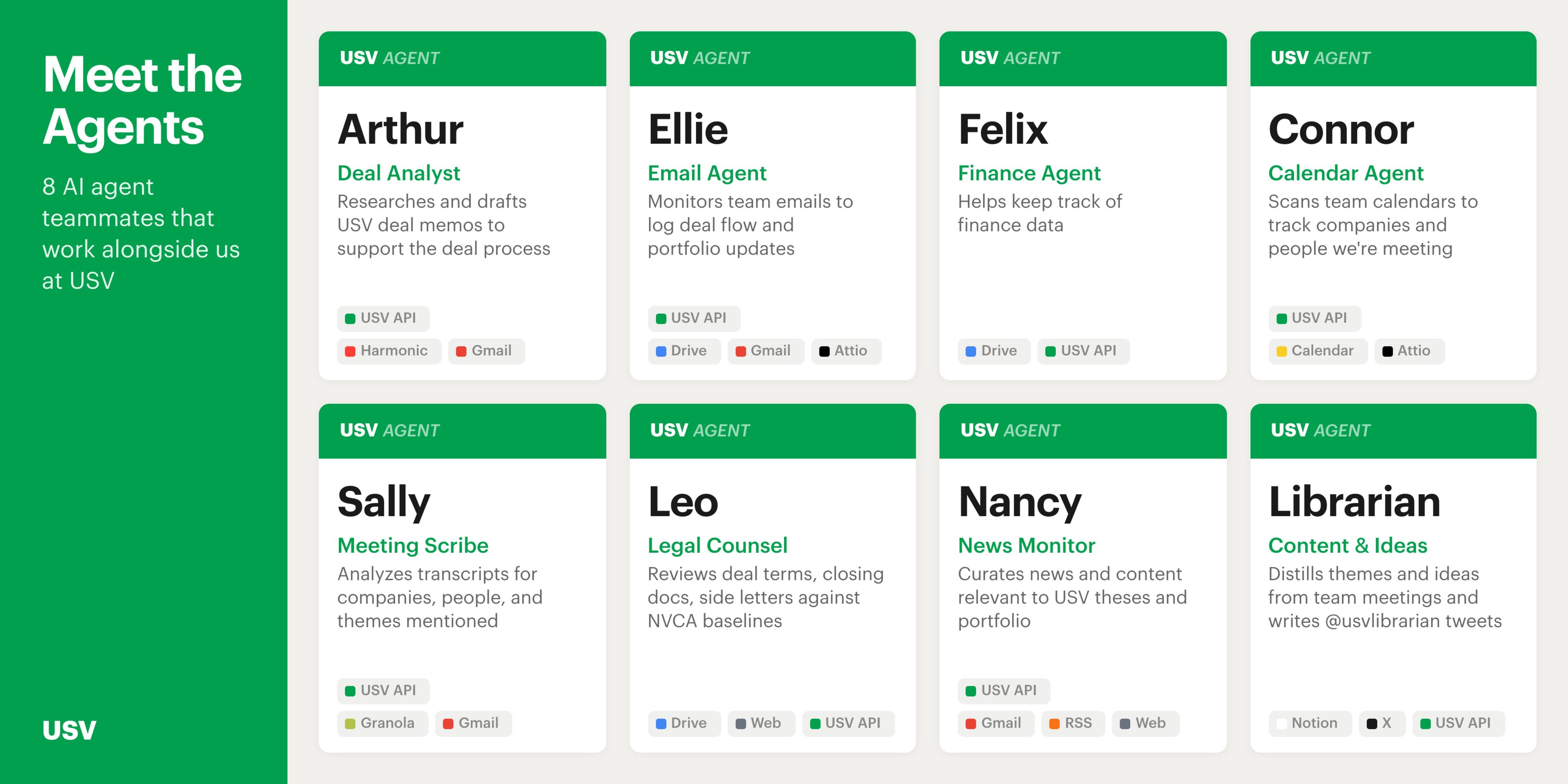
What problem it solves: At a firm like USV, information about companies, people, and themes is constantly generated across meetings, email threads, and calendars. The problem was that this context was scattered, manually maintained, and often outdated when the team needed it. The agents solve that by automatically capturing and structuring mentions across the firm’s workflows, creating a live internal memory layer for portfolio and pipeline discussions
How: USV first built a recap workflow for team meetings, then expanded it into its own internal database and web app. Background agents access Granola meeting transcripts, internal group email threads, and team calendars, then convert unstructured activity into structured “mentions” attached to companies and people. Those mentions feed the internal app, where companies automatically appear on the deal log with related decks, memos, and other internal context. Arthur also monitors the pipeline, maintains living deal memos, and supports investment discussions.
🛠️ Tools used: Claude Code, Tasklet, Granola, Notion, Attio, and the internal USV API. Arthur also uses Harmonic for research support.
Source: “Meet the Agents at USV: Arthur, Ellie, Sally, and Friends”, USV Blog, March 2026
HP Tech Ventures’ CVC agents
What: A team of specialised AI agents running on top of a structured internal knowledge layer, including agents for startup profiling, VC investment tracking, executive briefing synthesis, company evaluation, meeting briefing preparation, and a “Chief of Staff” orchestration agent.
What problem it solves: Corporate Venture Capital faces a unique challenge: proving strategic value to the parent company. The agents automate the cross-referencing and synthesis that connects deal pipeline activity to strategic priorities across HP’s business units.
How: HP built a team of purpose-built agents that share context but each own a specific workflow. In the past, the team had been tracking edge inference trends across articles, podcasts, and analyst reports. The Intel Digest agent picked up those signals, scored them against HP’s strategic priorities, clustered them with related signals already in the system, connected multiple startups in the pipeline to the same emerging theme, generated a themed briefing, created a standalone Insight note for specific HP business units, and produced follow-up actions.
🛠️ Tools used: Claude Code, Obsidian
Source: “The CVC Problem Nobody Talks About — and How AI Agents Solve It”, Andrew Bolwell, March 2026
5. Exiting
This is the white space.
Across every case study I came across, not a single vibe-coded tool was built for the exit process: secondary sales timing, M&A preparation, IPO readiness workflows, or portfolio exit modelling.
There are a few possible explanations. Exit processes tend to be highly bespoke, legally complex, and involve sensitive information that firms are reluctant to run through AI systems. The data required (buyer sentiment, secondary market dynamics, board-level strategic discussions) is harder to systematise than scraping founder LinkedIn profiles. And the stakes of getting it wrong are higher.
Reality check
The case studies above make for exciting reading, but the honest version of this story includes the cautionary tales.
The maintenance trap. Michael Bloch, a partner at Quiet Capital, spent around 50 hours building a command centre with Claude Code covering email, calendar, meeting notes, and CRM. It worked. The maintenance cost kept compounding while the usefulness never quite caught up. “I built something” Bloch wrote. “But I didn’t build a product. I built a prototype with no one maintaining it but me and a chatbot.”
Vibe coding makes building fast, but it doesn’t make maintaining easy (yet!)
The “building fast in the wrong direction” problem. USV’s Spencer Yen was candid about the risks: “The double-edged sword of AI coding agents is that you can build really fast in the wrong direction. When building internal tools or agents, the act of building can feel so engaging and productive that you lose sight of actually solving any real problems.”
The information edge is temporary. An associate at Vertex Ventures, Isaac Kwa, built an AI deal-sourcing tool and then wrote one of the most clear-eyed assessments of its limitations: “The best deals in VC do not surface through data”. If your AI can see the deal, so can everyone else’s AI. The tools being built are powerful, but they optimise the parts of VC that were never the sole source of alpha. Networks, judgment, and founder trust remain stubbornly human.
Closing note
The VC tech stack is being rebuilt in real time, one weekend project at a time.
It’s hard to say how much of this will stick in the long term. But for now, I see a lot of excitement and VC professionals having fun.
For inspiration on off-the-shelf AI tooling in VC, I highly recommend Cory Bolotsky’s newly released market map of AI VC tools.
do you guys have data on whether vibe-coding partners have different portfolio compositions than non-vibe-coding partners? supposedly yes sicne meaningfully more agentic AI, meaningfully less consumer subscription. but would love to see the analysis.